





Details
Description
Hans-jürgen eggert
1915 berlin-hemsdorf – 1945 döberitz
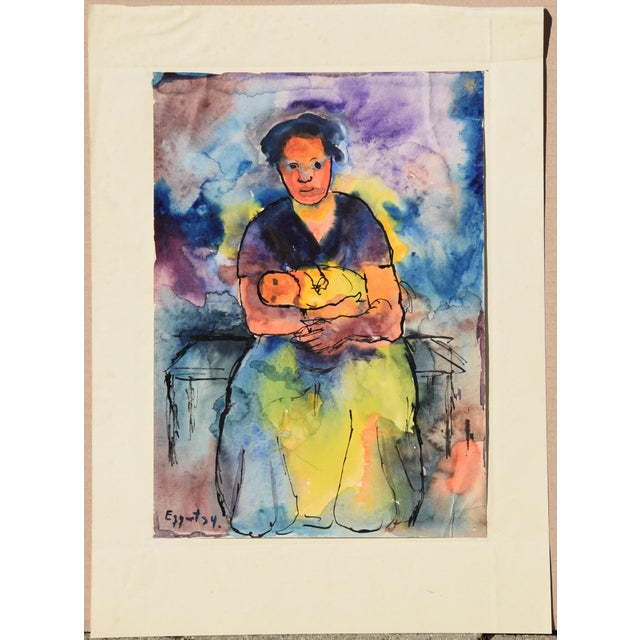
'mother with child'
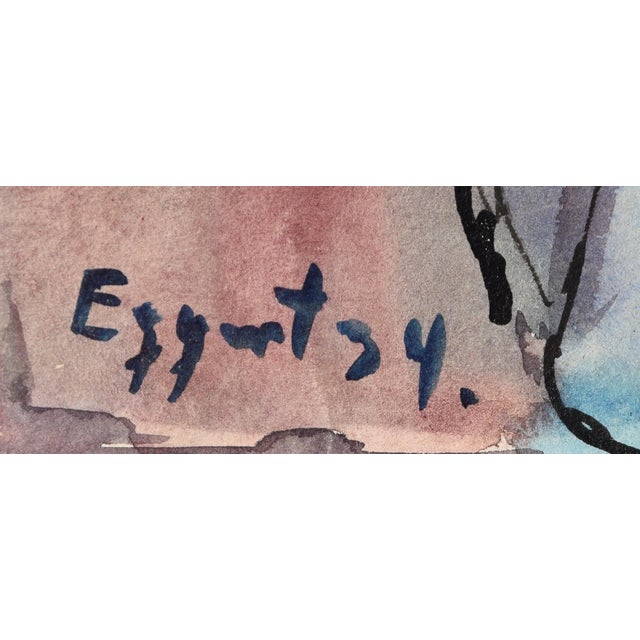
signed and dated lower left (1934)
watercolor and ink on …
Read more
Hans-jürgen eggert
1915 berlin-hemsdorf – 1945 döberitz
'mother with child'
signed and dated lower left (1934)
watercolor and ink on wove paper, mounted on sand-colored paper in the four corners on the reverse – unframed
size: 34.8 x 24.8 cm (sheet) / 46.9 x 33.9 cm (backing paper)
this watercolor is a vibrant and richly colored work from the artist's early period: a mother with her infant child, painted in 1934. Eggert was not yet 20 years old at the time and was still attending the berlin university of the arts!
____________________________
____________________________
hans-jürgen eggert
painter, draftsman, poet.
even in his youth, eggert had a great interest in art "and was captivated by modern painters. August macke, franz marc, paul klee, marc chagall, matisse, and picasso became his role models [\.]." (wladimir lindenberg)
his artistic and poetic work only became known posthumously, primarily through the efforts of his friend, dr. Vladimir lindenberg (1902 moscow – 1997 berlin), a physician who was also an artist.
1921–24 attended elementary school
1924–32 attended the paulsen gymnasium in berlin-steglitz (graduating in 1932 with the abitur, the highest level of secondary education).
1932–33 attended the school of applied arts and crafts ("school of applied arts of the east") in berlin.
1933–35 studied at the berlin university of the arts. During this time, he formed a friendship with helmut pelzer.
around this time, eggert also turned to poetry, influenced by, among others, georg trakl.
from 1935 to 1938, he worked independently as a painter, while also working in an office and as a security guard at a cinema on kurfürstendamm.
on april 4, 1938, he was drafted into the reich labor service.
"he cannot paint because he is not alone, and his painting would immediately reveal his true feelings. When he writes poetry, no one is allowed to see his poems; who in the third reich could possibly understand the most delicate lyricism? he guards his poems as a secret. He withdraws into himself and waits for this time to pass." (wladimir lindenberg)
after his reich labor service, he was drafted into military service on november 15, 1938.
he participated in the second world war from the beginning, taking part in the polish campaign and later in the west.
due to a nervous breakdown, he was admitted to a military hospital and later to a psychiatric clinic. Eggert is declared "no longer fit for front-line service."
in march 1941, he is discharged from the military hospital, but suffers from continued nervous tension and heart damage.
in the following years, eggert devotes himself to art and poetry in his private life.
eggert meets his future wife, constanze erdmann (1921-?), daughter of lothar erdmann (1888-1939) and elisabeth erdmann-macke (1888-1978), who was previously married to august macke.
in the spring of 1943, he is granted leave to study painting, but then has to return to military service.
in march 1943, the erdmann family home in berlin, where eggert is temporarily staying, is destroyed by a bombing raid.
july 1943: marriage.
constanze is emotionally distressed due to the bombing and the destruction of the house and travels to ried to stay with maria marc, widow of franz marc.
once again, eggert's apartment was destroyed in a bombing raid, and he found refuge with the sculptor countess dolina roedern (1887-1966), who became vladimir lindenberg's wife in 1947. Her apartment on kurfürstendamm became a meeting place for many artists and cultural figures critical of the regime, including karl hartung, heinz trökes, paul martin gensichen, and gerd kutscher.
during this time, countess dolina roedern also created a portrait bust of eggert and his wife, constanze.
in december 1943, their daughter iris was born.
in mid-1944, eggert was to be drafted into the military, but he suffered another nervous breakdown and had to be taken to a military hospital. The hospital was bombed, and eggert was transferred to a barracks. He was assigned as a clerk on the staff at the döberitz military training area.
december 1943: birth of their daughter iris. “on april 20, 1945, he left his makeshift home in berlin-schulzendorf early in the morning to reach the barracks in döberitz. It was a journey of no return. His trail remains shrouded in darkness. No one ever came forward to report having met hans jürgen eggert. Nor was there ever any confirmation of his death…” (vladimir lindenberg).
in 1975, his wife received a report from the red cross about fighting in the berlin area during the final days of the war, indicating that hans-jürgen eggert was presumed to have fallen during these battles.
“i am very calm and serene. I am confident that my life, which is only just beginning, will not be brutally cut short. I still have much to give to humanity, and i hope that my art will continue to grow, that it will become greater and more expansive” (eggert’s letter of september 9, 1943).
writings: 38 poems published privately in 1942; (posthumously) 1954 "when we must die and are in need: poems and drawings from the estate." (stierstadt i. T.: eremiten-presse)
collections:
graphothek, berlin
museum ludwig, cologne
group exhibitions:
1945 "exhibition of young art," galerie gerd rosen, berlin (with works by wladimir lindenberg and heinz trökes)
1946 "art exhibition of the west," schöneberg town hall, berlin
1946 "masks, dreams, and visions," berlin cultural collective 1946, "die raumgestalter" interior design store, berlin
solo exhibitions:
september 1943 galerie günther franke, munich
1946 galerie gerd rosen, berlin
1949 poems & watercolors, galerie hanna bekker vom rath, frankfurt am main
1960 vaganten-keller, berlin
1985 kunstamt reinickendorf, berlin this piece has an attribution mark,
i am sure that it is completely authentic and take full responsibility for any authenticity
issues arising from misattribution
See less
- Dimensions
- 9.45ʺW × 13.39ʺH
- Styles
- Modern
- Art Subjects
- Nude
- Period
- 1930s
- Country of Origin
- Germany
- Item Type
- Vintage, Antique or Pre-owned
- Materials
- Paper
- Condition
- Good Condition, Unknown, Some Imperfections
- Color
- Condition Notes
- Good — This vintage item remains fully functional, but it shows sign of age through scuffs, dings, faded finishes, minimal … moreGood — This vintage item remains fully functional, but it shows sign of age through scuffs, dings, faded finishes, minimal upholstery defects, or visible repairs\. Sheet verso attached to paper at the four corners; crushed in the upper right corner; slightly creased in the lower right corne less
Returns & Cancellations
Return Policy - All sales are final 48 hours after delivery, unless otherwise specified in the description of the product.
Cancellation Policy - Prior to shipping or local pickup, buyers may cancel an order for up to 48 hours, unless otherwise specified.
Related Collections
- Photorealism Canvas Paintings
- Ed Ruscha Paintings
- Photorealism Paintings in New York
- Richard Serra Paintings
- Jo Baskerville Paintings
- Louise Nevelson Paintings
- Karen Offutt Paintings
- Nicola Simbari Paintings
- Herman Miller Paintings
- BDDW Paintings
- James McCray Paintings
- Jaanika Peerna Paintings
- Leroy Neiman Paintings
- Jeff Slemmons Paintings
- Vienna Secession Paintings
- Johannes Andersen Paintings
- Pedro Friedeberg Paintings
- Peter Behrens Paintings
- Piet Hein Eek Paintings
- Raphael Paintings
- Photorealism Paintings in Los Angeles
- Carl-Axel Acking Paintings
- Karl-Erik Ekselius Paintings
- Hans Andersen Paintings
- Jean-Paul Barray Paintings