






Details
Description
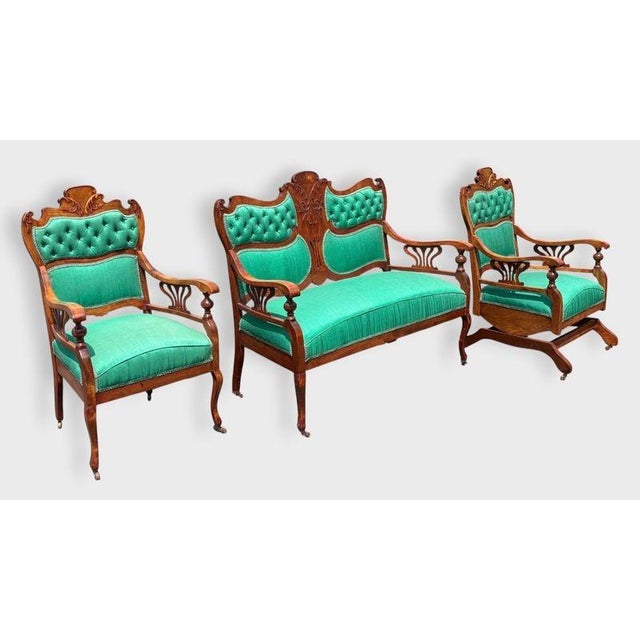
A wonderfully eccentric three-piece American walnut parlor suite dating to the turn of the 20th century, pairing sculptural Victorian–Art Nouveau …
Read more
A wonderfully eccentric three-piece American walnut parlor suite dating to the turn of the 20th century, pairing sculptural Victorian–Art Nouveau carving with unabashedly color-forward malachite-green upholstery.
Comprising a two-seat settee, stationary armchair and coordinating platform rocking chair, the suite survives as a cohesive ensemble. Each piece repeats the same curving walnut framework, shaped upholstered back, pierced arm supports and jewel-toned textile, allowing the group to furnish an entire conversation area with immediate architectural presence.
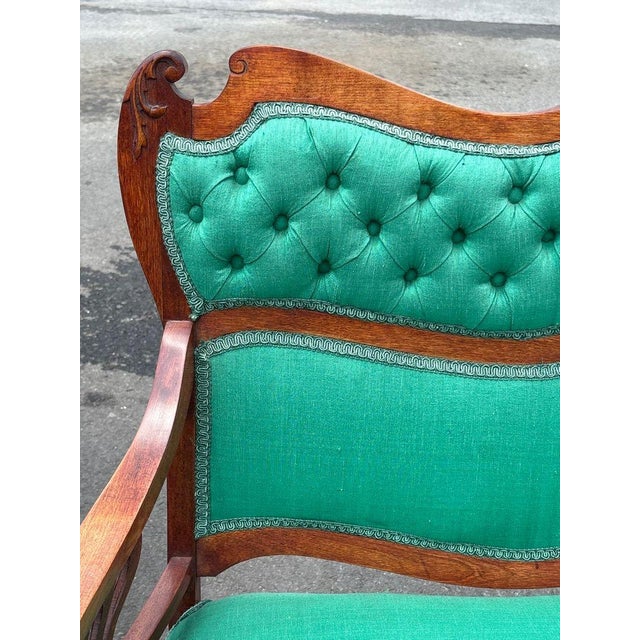
The settee is the suite’s dramatic centerpiece. Its divided back rises toward a commanding central walnut crest carved with mirrored foliate scrolls. The leaves sweep upward and outward in elongated, whiplash-like curves before curling inward around a shield-shaped central panel.
Twin upper-back panels follow the undulating silhouette of the crest and are deeply button-tufted with self-covered buttons. Below, shaped upholstered panels echo the curves above, while a trio of slender pierced openings punctuates the central walnut support.
The result is unusually animated: carving, upholstery and negative space move rhythmically across the back rather than forming the rigid, heavily enclosed structure associated with earlier Victorian seating.
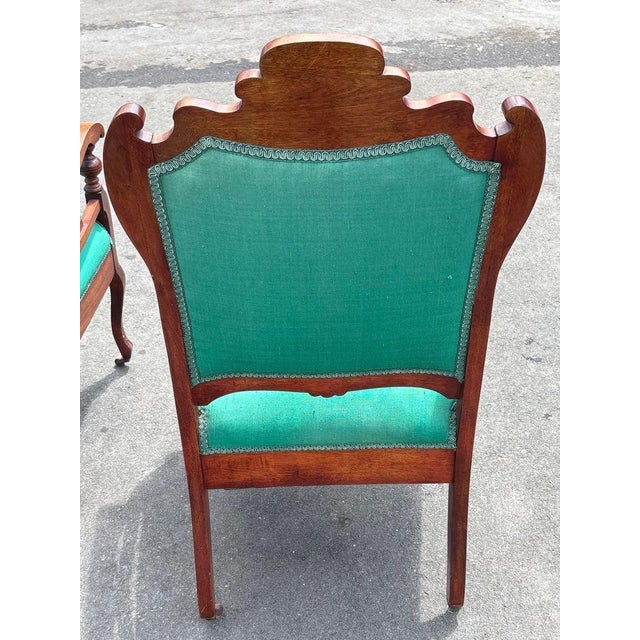
The stationary armchair repeats the settee’s scrolling foliate crest and sculptural upholstered back on a more intimate scale. Its long, gently bowed arms terminate above turned front supports, while pierced lyre-like panels introduce an elegant open quality beneath each arm.
Slender shaped legs and surviving casters give the chair a poised, lightly elevated profile. The armchair is substantial enough to stand independently as a fireside or occasional chair while remaining visually connected to the larger suite.
The platform rocking chair is the group’s most unusual component. Rather than resting on long exposed runners, its upholstered chair frame moves above a low stationary platform. This late-19th-century innovation allowed the sitter to rock without the chair traveling across or wearing an expensive parlor carpet.
Its wide arms, pierced supports, upholstered back and carved crest correspond with the stationary chair, but its distinctive base gives it additional visual weight and sculptural interest. It is both a functional seating form and a fascinating piece of turn-of-the-century mechanical furniture.
The suite’s walnut frames display striking natural grain and warm amber-to-reddish-brown coloration. Broad areas of timber within the settee’s central crest and the chairs’ shaped rails allow the figure of the wood to become part of the decorative composition.
Stylized leaf carving appears to grow directly from the frames, softening their architectural structure and signaling the period’s transition from Victorian historicism toward Art Nouveau’s fascination with botanical form and continuous line.
The current upholstery is a later textile in an extraordinary shade that moves between emerald, malachite and peacock green as the light changes. Its slight sheen intensifies the color, while traditional button tufting, self-covered buttons, piping and coordinating gimp trim preserve the suite’s formal character.
Far from requiring a neutral room, this suite invites an equally confident interior. Imagine it against aubergine, lacquered oxblood, tobacco brown, peacock blue or deeply saturated floral wallpaper, layered with antique brass, skirted tables, patterned rugs and an unapologetic collection of paintings and objects.
In a jewel-box library or drawing room, the walnut supplies grounding warmth while the green upholstery introduces a vivid, almost theatrical note. Against quieter plaster or paneled walls, the suite becomes the room’s defining color story.
For a high-end designer, the three pieces offer considerable flexibility. Kept together, they establish a complete conversation grouping with a sense of history and occasion. Separated, the settee can anchor a bedroom, entry hall or intimate sitting room while the two chairs appear elsewhere as related sculptural accents.
The settee’s compact 48½-inch width makes it especially useful where a full-size sofa would overwhelm the architecture. It could sit beneath a significant painting, at the foot of a bed, between bookcases or opposite a fireplace.
The stationary chair is well suited to a dressing room, salon or paneled study. The platform rocker provides a distinctive reading chair for a library, bedroom or highly individual nursery—an unexpected antique alternative to conventional upholstered seating.
The existing color gives the suite a ready-made eccentric traditionalism that feels especially relevant within Grandmillennial, maximalist and collected interiors. It would layer beautifully with chinoiserie, animal prints, tartans, needlepoint, paisley, antique textiles and blue-and-white porcelain.
Alternatively, the frames offer exceptional possibilities for a future custom-upholstery commission. A designer might retain the monochromatic jewel-box effect in mohair or silk velvet, introduce a botanical print across the lower panels, or contrast the tufted crests with patterned seats and solid welting.
Whether preserved in its audacious green or reimagined in couture textiles, the suite’s true asset is its complete underlying composition: three coordinated forms, hand-worked walnut details and a rare platform rocker united by the same fluid design language.
A memorable ensemble for the collector who prefers rooms with personality—historically grounded, decoratively fearless and impossible to mistake for newly manufactured furniture.
DESIGN AND PERIOD IDENTIFICATION
The suite combines construction and decorative features associated with American late-Victorian parlor furniture: coordinated seating forms, button-tufted backs, turned front supports, shaped legs, casters and a platform-rocker mechanism.
Its asymmetrical scrolling crests, stylized foliate carving, curving upholstered panels and elongated lines demonstrate the influence of Art Nouveau as the style entered American decorative design around the turn of the 20th century.
The set is therefore cataloged as American Victorian–Art Nouveau transitional furniture dating approximately 1895–1910, rather than attributed to a specific European Art Nouveau school.
No maker’s label, factory stencil or documented manufacturer has been identified from the available photographs. The suite should not be attributed to a named maker without additional physical evidence.
DOCUMENTATION AND PROVENANCE
Historical purchase records retained with the suite identify it as an antique three-piece hand-carved walnut Art Nouveau set comprising a settee, armchair and rocking chair.
The records document dimensions of approximately 48½ inches wide by 23 inches deep by 40½ inches high. These measurements correspond to the settee, the largest component.
The walnut identification recorded in the historical documentation is consistent with the visible grain, color and carving characteristics. No laboratory wood analysis has been performed.
PROVENANCE
Private collection
Accompanied by supporting historical purchase documentation
KEYWORDS
antique walnut parlor suite, Victorian Art Nouveau furniture, malachite green furniture, emerald green antique seating, three piece parlor set, carved walnut settee, antique platform rocking chair, walnut armchair and settee, circa 1900 furniture, American Art Nouveau seating, Victorian conversation set, eccentric traditional furniture, color forward interior, jewel tone furniture, maximalist antique seating, Grandmillennial furniture, peacock green upholstery, carved botanical furniture, button tufted settee, Victorian living room set, antique walnut rocker, stationary platform rocker, pierced lyre arm chair, romantic interior furniture, jewel box library, designer parlor suite, collected traditional interior, statement antique seating, antique salon suite, dopamine decor furniture, bold green antique furniture, Victorian loveseat, custom upholstery project
See less
- Dimensions
- 48.5ʺW × 23ʺD × 40.5ʺH
- Styles
- Art Nouveau
- Victorian
- Seat Height
- 20.0 in
- Number of Seats
- 4
- Period
- Late 19th Century
- Country of Origin
- United States
- Item Type
- Vintage, Antique or Pre-owned
- Materials
- Fabric
- Ornamental & Decorative Materials
- Walnut
- Condition
- Good Condition, Unknown, Some Imperfections
- Color
- Green
- Condition Notes
- Good antique condition with wear, modifications and upholstery condition consistent with age and use. The walnut frames retain their flowing … moreGood antique condition with wear, modifications and upholstery condition consistent with age and use. The walnut frames retain their flowing crests, carved foliate ornament, shaped rails, pierced arm supports and turned details. No major carved losses are apparent in the available photographs. Visible age-related wear includes scattered scratches, abrasions, small finish losses, edge rubbing, darker areas and natural tonal variation. The legs, arms and seat rails show localized marks consistent with generations of handling and use. The malachite-green upholstery is a later replacement rather than the suite’s documented original covering. It remains highly decorative and presents with vivid, saturated color. The textile displays scattered small spots, dark marks, minor surface soiling, subtle color variation, light wrinkling and localized wear. The settee seat shows visible areas of faint staining or discoloration. The decorative gimp trim exhibits minor irregularities, wear and occasional looseness. The button-tufted upper panels retain their self-covered buttons. The interior padding, springs, webbing and underlying upholstery materials have not been opened or professionally examined. The stationary settee and armchair retain metal casters. The platform rocking chair retains its stationary base and associated rocker hardware. The age and originality of individual casters, upholstery components and mechanical hardware have not been independently established. Please review all photographs closely, particularly the carved crests, upholstery surfaces, trim, arms, legs, casters and platform-rocker base. Variations and imperfections visible in the photographs form part of the condition description. less
Questions about the item?
Returns & Cancellations
Return Policy - All sales are final 48 hours after delivery, unless otherwise specified in the description of the product.
Cancellation Policy - Prior to shipping or local pickup, buyers may cancel an order for up to 48 hours, unless otherwise specified.