


Details
Description
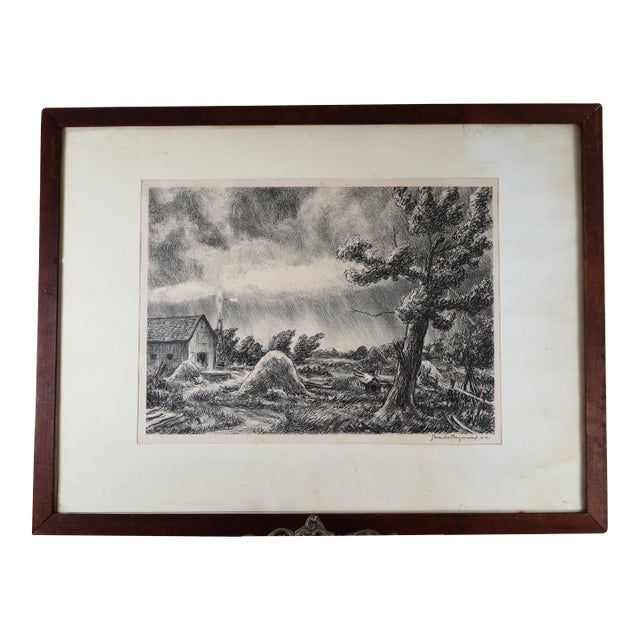
A signed impression of Wind and Rain, a documented 1931 lithograph by American painter, printmaker and illustrator Grant Tyson Reynard …
Read more
A signed impression of Wind and Rain, a documented 1931 lithograph by American painter, printmaker and illustrator Grant Tyson Reynard (1887–1968).
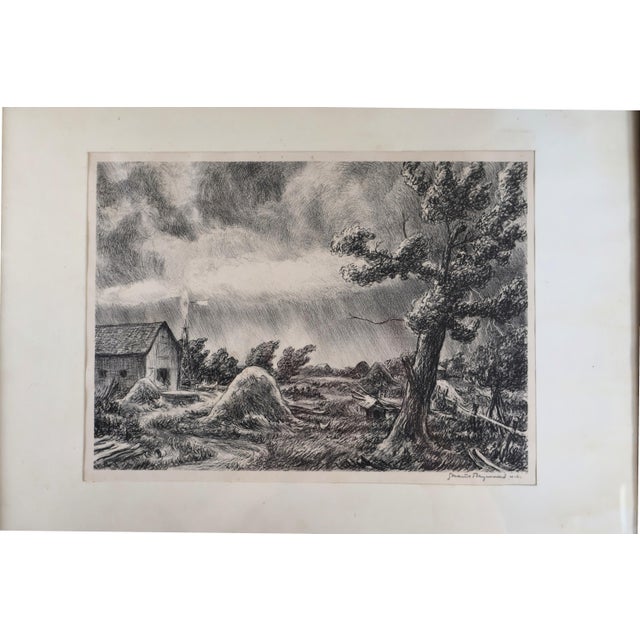
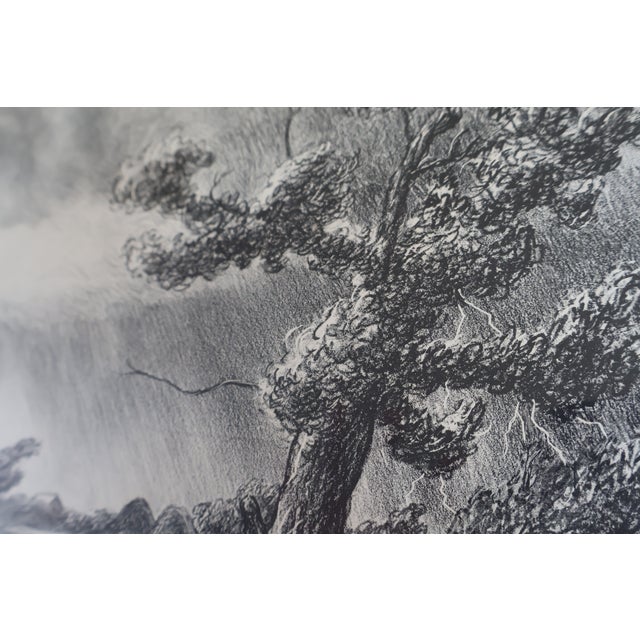
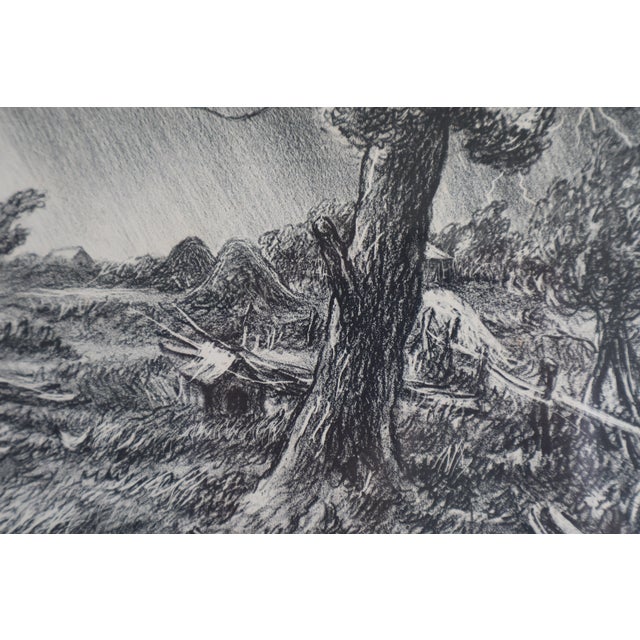
Reynard transforms a rural farmstead into a remarkably dynamic study of weather and movement. A darkening sky descends over an open agricultural landscape as wind drives the rain diagonally across the composition. Trees and crops bend beneath the force of the storm, a windmill turns nearly to a blur, and a jagged bolt of lightning appears at the far right.
A barn and conical haystacks anchor the exposed farmland, while the monumental tree in the foreground gives the landscape its dramatic structure. The tree’s dark trunk and sweeping canopy frame the advancing storm, contrasting with the luminous band of rain crossing the middle distance.
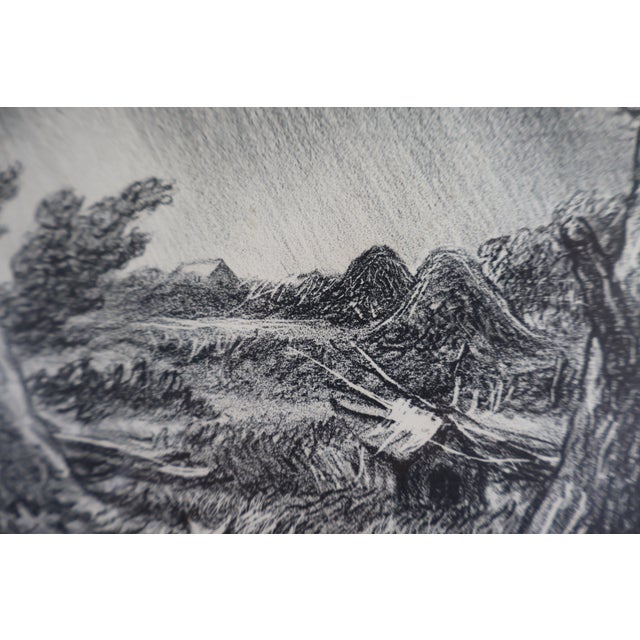
The lithograph is especially compelling for Reynard’s handling of atmosphere. Closely layered marks build the heavy storm clouds, while directional lines create the sensation of rain traveling across the fields. Dark, densely worked foliage alternates with open areas of paper, producing a landscape that feels both immediate and expansive.
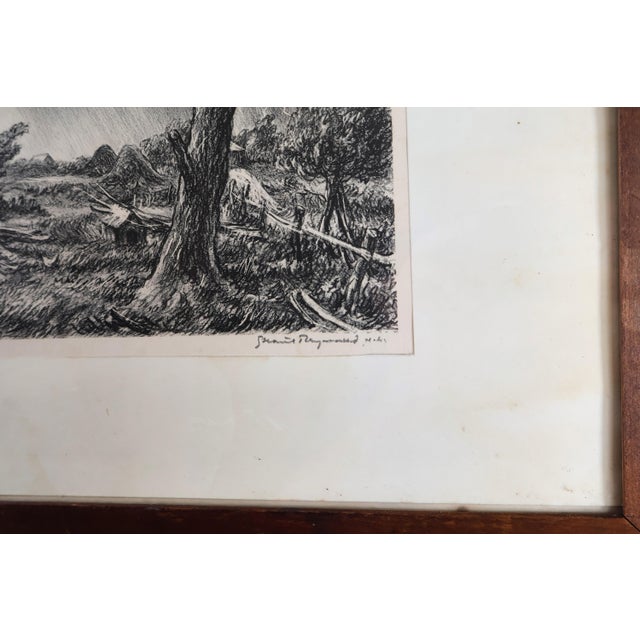
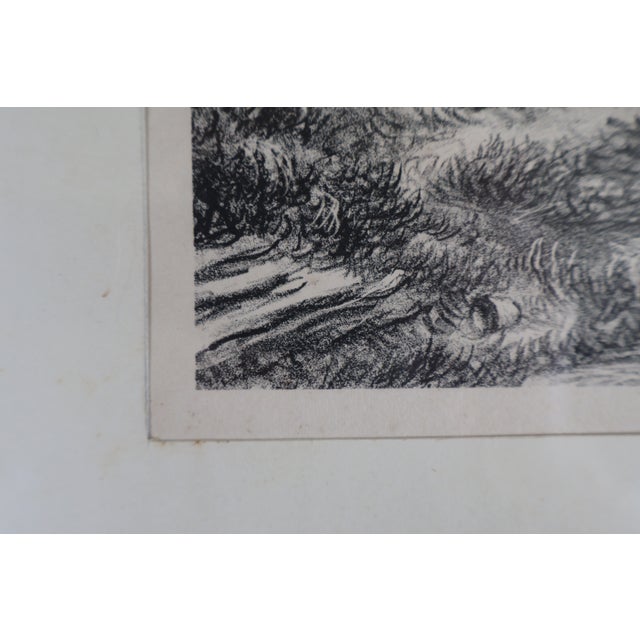
The work is signed “Grant Reynard, N.A.” in graphite beneath the image at lower right. The initials “N.A.” denote Reynard’s status as a full National Academician. He was elected an Associate of the National Academy of Design in 1940 and a full Academician in 1963.
Because the composition was created in 1931 but Reynard did not attain full National Academician status until 1963, the “N.A.” inscription indicates that this impression was signed in or after 1963. This distinction does not change the 1931 creation date of the lithographic image.
Wind and Rain is a recognized composition within Reynard’s graphic oeuvre. Impressions are held by both The Metropolitan Museum of Art and the National Academy of Design. The National Academy’s impression served as Reynard’s diploma presentation upon his election as a full Academician in 1963.
The museum-recorded image measures approximately 8⅞ inches high by 12½ inches wide, with a sheet measuring approximately 11½ inches high by 15⅞ inches wide. These documented proportions correspond with the visible image and margins of the present framed impression.
For an interior designer or collector, the lithograph offers the atmosphere and narrative depth of an American landscape while retaining a versatile monochromatic palette. Its expressive weather, agricultural subject and warm wood presentation are particularly suited to traditional, Americana, English country and thoughtfully collected interiors.
The horizontal format works beautifully above a writing desk, diminutive chest or console. It would also bring a strong grounding element to a paneled study, library, country-house bedroom, stairway gallery or salon-style grouping of historic works on paper.
Its charcoal, cream and warm-brown palette layers naturally with antique woods, aged leather, equestrian objects, stoneware, woven textiles, tartans and early American furnishings. In a more contemporary setting, the vigorous black-and-white composition offers an atmospheric counterpoint to cleaner lines and quieter materials.
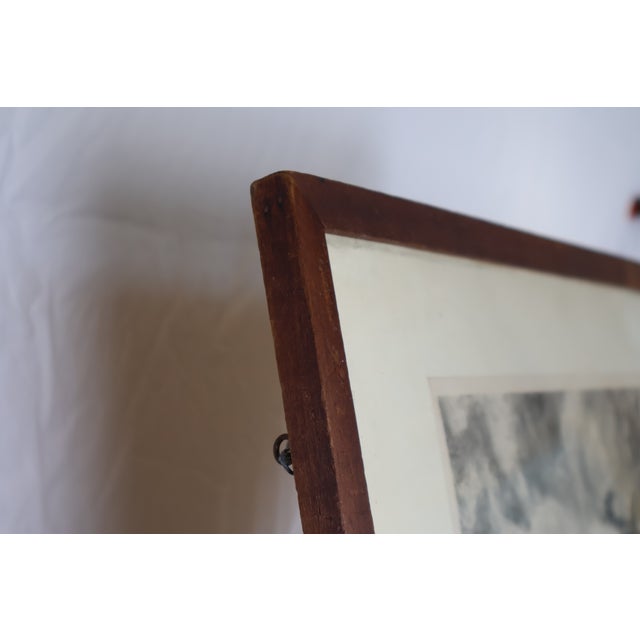
Presented beneath glass with a generous cream mat and a restrained warm-brown wood frame, the work retains an authentically aged character. The visible foxing, tonal variation and frame wear should be considered part of its vintage condition and are documented in the accompanying photographs.
A compelling example of early-20th-century American printmaking, distinguished by its museum-documented composition, evocative regional subject and graphite signature from a recognized National Academician.
ARTIST BIOGRAPHY
Grant Tyson Reynard was born in Grand Island, Nebraska, in 1887. Raised in a musical family and initially trained as a pianist, he turned to visual art and attended evening classes at the School of the Art Institute of Chicago in 1906–1907.
In 1913, Reynard became art director of Red Book and subsequently contributed illustrations to Red Book, Collier’s and The Saturday Evening Post. After settling in Leonia, New Jersey, he continued his artistic training with Charles Chapman, Harvey Dunn, Mahonri Young and Harry Wickey.
Beginning in 1926, Reynard spent twelve summers as a fellow at the MacDowell Colony in Peterborough, New Hampshire. He worked extensively in etching and lithography while also developing a reputation as a painter in oil and watercolor.
Reynard taught at the Grand Central School of Art and later traveled extensively as an artist, lecturer and painting instructor. He served as chairman of the Montclair Art Museum’s art committee before becoming the museum’s president, a position he held for approximately a decade.
He was elected an Associate of the National Academy of Design in 1940 and a full National Academician in 1963. Reynard’s work is represented in institutional collections including The Metropolitan Museum of Art, National Gallery of Art, Smithsonian American Art Museum, National Academy of Design and Museum of Nebraska Art.
DOCUMENTATION, SIGNATURE AND PROVENANCE
Signed “Grant Reynard, N.A.” in graphite beneath the image at lower right.
Historical purchase records retained with the artwork identify Grant Tyson Reynard as the artist, Wind and Rain as the title, lithograph as the medium and the signature as located at lower right. These records serve as supporting provenance.
The title, artist, date, medium, composition and dimensions correspond with institutional catalog records for Reynard’s Wind and Rain. The Metropolitan Museum of Art catalogs the composition as a circa-1931 lithograph. The National Academy of Design dates it to 1931 and records its impression as Reynard’s National Academician diploma presentation of May 6, 1963.
The National Academy also records the same graphite inscription—“Grant Reynard, N.A.”—on its impression.
No edition number is visible through the current framing, and neither consulted institutional record publishes an edition size. Accordingly, this work is described as a signed impression without representing a numbered edition or specific edition size.
PROVENANCE
Private collection
Accompanied by supporting historical purchase documentation
KEYWORDS
Grant Tyson Reynard lithograph, Grant Reynard signed print, Wind and Rain lithograph, 1931 American lithograph, signed American landscape, American Regionalist print, National Academician artist, museum collection artist, vintage storm landscape, rural American landscape, farm landscape lithograph, windmill landscape art, lightning storm artwork, windswept trees print, vintage agricultural art, Americana wall decor, traditional landscape print, English country wall art, paneled library artwork, farmhouse landscape art, early twentieth century print, black and white landscape, graphite signed lithograph, framed vintage print, American printmaking, designer traditional wall art, collected gallery wall, historic works on paper, atmospheric landscape art, monochromatic American art
See less
- Dimensions
- 20.51ʺW × 1ʺD × 15.5ʺH
- Frame Type
- Framed
- Period
- Early 20th Century
- Country of Origin
- United States
- Item Type
- Vintage, Antique or Pre-owned
- Materials
- Glass
- Lithograph
- Paper
- Pencil
- Wood
- Condition
- Good Condition, Unknown, Some Imperfections
- Color
- Black
- Condition Notes
- Good vintage condition, retaining strong tonal contrast and clearly articulated lithographic detail. The densely worked storm clouds, rain, windblown trees, … moreGood vintage condition, retaining strong tonal contrast and clearly articulated lithographic detail. The densely worked storm clouds, rain, windblown trees, barn, windmill and haystacks remain visually compelling. The work is signed “Grant Reynard, N.A.” beneath the image at lower right. The visible paper displays age-appropriate toning and scattered foxing, including small brown spots within the margins and isolated spots extending into portions of the printed image. No tears, punctures or significant losses to the visible paper were observed through the glass. The cream mat exhibits overall age toning, scattered foxing, small marks and areas of discoloration. A patch of surface disturbance or possible adhesive residue is visible near the upper center of the mat. The vintage warm-brown wood frame displays scratches, abrasions, edge wear, finish loss, darkened areas and small gaps or irregularities at the mitered corners, consistent with age and use. The protective glass remains intact. The reverse is fitted with an aged cardboard backing secured by nails and a later metal hanging wire. The backing displays toning, surface wear and a small area of paper loss near the upper-left corner. The hanging wire remains functional but is simply installed. The artwork has not been removed from its frame. The condition of the complete sheet and areas concealed beneath the mat has therefore not been examined. No edition number is visible through the current presentation. Please review all photographs closely, particularly the detailed images of the signature, printed surface, foxing, mat, frame corners, backing and hanging hardware. less
Questions about the item?
Returns & Cancellations
Return Policy - All sales are final 48 hours after delivery, unless otherwise specified in the description of the product.
Cancellation Policy - Prior to shipping or local pickup, buyers may cancel an order for up to 48 hours, unless otherwise specified.
Related Collections
- George Barbier Original Prints
- Gustave Baumann Original Prints
- Silver Finish Original Prints
- Robert Kipniss Original Prints
- Rattan Original Prints
- Dye Transfer Original Prints
- Louis XIII Original Prints
- Johannes Kip Original Prints
- Medium-Density Fibreboard Original Prints
- Botanical Prints
- Framed Prints
- Bird Prints
- Woodblock Prints
- Screen Prints
- Japanese Woodblock Prints
- Thomas McKnight Original Prints
- Frank Stella Original Prints
- Teak Original Prints
- Chaim Gross Original Prints